D60 Chart Calculator: How to Calculate and Read Your Shashtiamsa Chart (2026 Guide)
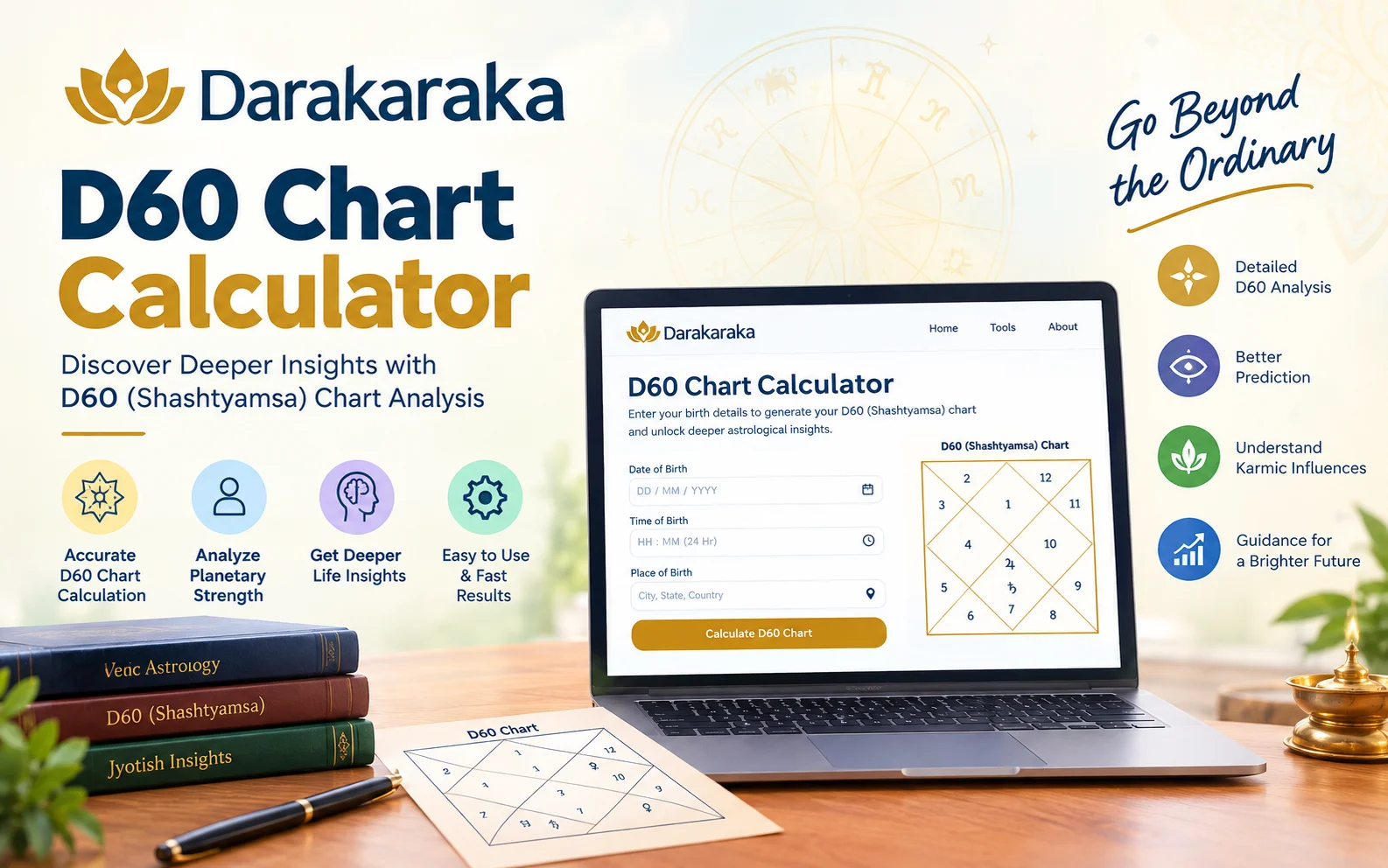
Quick Answer: A D60 Chart Calculator divides each zodiac sign into 60 parts of 0.5° each and generates the Shashtiamsa chart used in Vedic astrology. Because these divisions are extremely fine, even a small birth-time difference can change sensitive D60 placements. Use the chart alongside the D1 chart rather than treating it as a standalone chart.
A D60 Chart Calculator splits every zodiac sign into 60 tiny slices of 0.5° each, so you can examine the finest divisional detail of your birth chart, provided your birth time is sufficiently precise.
Here is a confession from years of casting charts: the D60 is the chart people open with the most excitement and abandon with the most confusion. It looks like a normal chart, yet a small birth-time error can rewrite sensitive D60 placements completely.
This guide covers how a D60 Chart Calculator works, how to run one online for free, and how to approach the result without overstating what the chart can tell you. It is updated for 2026.
Ananya Sharma · 14 Aug 1994, 06:42 · Lahiri
|
Pi
Ke |
Ar
Su |
Ta
Me Ju |
Ge
|
|
Aq
Mo |
D60
Shashtiamsa
Lagna: Sagittarius |
Cn
|
|
|
Cp
|
Le
|
||
|
Sg
Asc Ma Sa Lagna
|
Sc
|
Li
|
Vi
Ve Ra |
| Planet | D1 Position | D60 Sign | Amsa No. |
|---|---|---|---|
| Asc | Leo 20°00′ | Sagittarius | 41 |
| Sun | Leo 28°13′ | Aries | 57 |
| Moon | Cancer 9°40′ | Aquarius | 20 |
| Mars | Gemini 3°04′ | Sagittarius | 7 |
| Mercury | Leo 16°52′ | Taurus | 34 |
| Jupiter | Libra 21°30′ | Taurus | 44 |
| Venus | Scorpio 5°24′ | Virgo | 11 |
| Saturn | Aquarius 5°11′ | Sagittarius | 11 |
| Rahu | Sagittarius 10°54′ | Virgo | 22 |
| Ketu | Gemini 10°54′ | Pisces | 22 |
What Is the D60 Chart (Shashtiamsa)?
The D60 is the sixtieth divisional chart, or varga, in Vedic astrology. Its Sanskrit name is Shashtiamsa: shashti means sixty and amsa means part.
Each 30° zodiac sign is divided into 60 parts. Each part measures 0.5°, or 30 arcminutes.
Quick Definitions
Vedic astrology uses a sidereal zodiac, and Lahiri (Chitrapaksha) is one of the commonly used ayanamsa settings. Different ayanamsa settings can produce slightly different planetary positions, which matters greatly when working with a division as small as 0.5°.
Brihat Parashara Hora Shastra (BPHS) describes the Shodashavarga framework of sixteen divisional charts and gives the Shashtiamsa division its own set of names and traditional qualities. In traditional Vedic astrology, D60 is often associated with deep karmic themes and past-life interpretations. These spiritual interpretations are matters of astrological tradition rather than scientifically established facts.
How a D1 to D60 Chart Calculator Works
A D1 to D60 Chart Calculator takes planetary longitudes from the birth chart and converts them into D60 positions. The arithmetic is straightforward; the exact implementation is where precision and tradition matter.
Basic Calculation Concept
- Take the planet’s degree within its zodiac sign, from 0° to 29°59′.
- Divide the degree within the sign by 0.5° to identify its Shashtiamsa section.
- Determine the corresponding D60 sign using the applicable classical Shashtiamsa counting rule.
- Repeat the process for the relevant planets and the ascendant.
Important:
D60 calculation is not simply a universal “count forward from the same sign” formula in every Vedic astrology implementation. Classical methods distinguish how the 60 divisions are assigned, including differences between odd and even signs. Therefore, when comparing calculators, make sure they use the same D60 tradition, ayanamsa and calculation settings.
Worked Example: Sun at 15°20′ Leo
15°20′ equals approximately 15.33°. Dividing by 0.5° gives approximately 30.67, placing the Sun in the 31st Shashtiamsa.
The exact D60 sign assignment then depends on the classical counting convention used by the calculator, including whether the natal sign is odd or even. This is one reason two calculators can sometimes display different D60 results despite using the same birth data.
A properly configured D60 Chart Calculator Online performs these calculations for the ascendant and planets automatically.
D60 Chart Calculator Free Online: What to Look For
There are plenty of free D60 chart calculator options. Vedic astrology platforms and desktop programs can generate divisional charts, but the important question is not simply whether a tool is free. Check the settings and calculation method before comparing results.
Author POV: When comparing two tools, run the same known birth data through both and compare the underlying D1 ascendant and planetary degrees first. If those settings differ, a D60 difference may simply reflect different astronomical or calculation settings.
Why Birth Time Makes or Breaks Your D60 Chart Calculator Result
This is one of the most important considerations when working with a D60 chart. Because each zodiac sign is divided into only 0.5° sections, a small change in the underlying ascendant degree can move a placement from one Shashtiamsa to another.
The important point is simple: the finer the divisional chart, the more important accurate underlying birth data becomes.
Mini Case Study: A 4-Minute Birth-Time Difference
Consider an illustrative case where a birth certificate records 6:10 AM, while family recollection suggests approximately 6:14 AM.
At 6:10 AM: the ascendant may be around a particular degree within Taurus, placing it in one Shashtiamsa section.
At 6:14 AM: the ascendant has moved further through Taurus and may cross one or more D60 boundaries depending on the exact astronomical calculation.
The exact D60 result should be calculated from the actual location, time zone and astronomical positions rather than estimated from a rounded example. This is why birth-time rectification, when used within a particular astrological tradition, should be handled carefully rather than assuming that every four-minute difference produces the same D60 change.
D60 Chart Calculator and Interpretation: A 5-Step Workflow
Getting a chart is easy. Interpreting it responsibly requires more care. Here is a practical workflow.
Step 1: Confirm the Birth Data
Use the most reliable birth record available. Note whether the time is exact, rounded or based on memory.
Step 2: Generate D1 and D60 Side by Side
Keep the D1 birth chart available so you can compare the divisional chart with the main chart.
Step 3: Check the Reliability Gate
If the birth time is uncertain by several minutes, treat sensitive D60 placements as provisional rather than definitive.
Step 4: Examine the D60 Lagna and Lagna Lord
Within traditional Vedic astrology, practitioners often begin with the D60 ascendant, its lord and important planetary placements.
Step 5: Cross-Check Against D1
Use D60 as a supporting divisional chart and compare its themes with the D1 and other relevant vargas rather than reading it in isolation.
The Shashtiamsa Names: Nature of Each Slice
Traditional texts assign names and qualities to the 60 Shashtiamsa divisions. Examples commonly encountered in traditional lists include Ghora, Rakshasa, Deva, Kubera, Yaksha and Kinnara.
Within traditional astrological interpretation, some Shashtiamsa names are considered more auspicious while others are considered more challenging. The sequence and interpretation also depend on the sign and calculation tradition being used.
Why this matters: If a D60 calculator provides the Shashtiamsa name as well as the sign, it gives the reader more information to compare with the traditional interpretation. These meanings belong to the Vedic astrological tradition and should not be treated as scientifically validated personality or life predictions.
D60 Chart Calculator With Nakshatra: Adding a Second Layer
Each nakshatra spans 13°20′, and the zodiac contains 27 nakshatras. A D60 Chart Calculator With Nakshatra can therefore provide another reference layer alongside the D60 positions.
- The D1 Moon nakshatra can be examined as part of traditional emotional and mental analysis.
- The D60 lagna and planetary placements provide the divisional-chart layer.
- Practitioners may also compare nakshatra lords with the D1, D60 and relevant dasha periods.
Practical tip: Treat nakshatra-based D60 analysis as an additional interpretive layer rather than a replacement for the main birth chart.
D60 Chart Calculator in Hindi (डी60 चार्ट कैलकुलेटर)
हिंदी में D60 को षष्ट्यंश वर्ग कहा जाता है। यह कुंडली के सूक्ष्म विभाजनों में से एक है, जिसमें हर राशि के 60 भाग होते हैं और हर भाग 0.5° का होता है।
D60 Chart Calculator in Hindi चुनते समय इन बातों पर ध्यान रखें:
- जन्म समय जितना संभव हो उतना सटीक हो।
- अयनांश, जैसे लाहिड़ी, सभी गणनाओं में एक जैसा रखा जाए।
- षष्ट्यंश के नाम और संबंधित विवरण उपलब्ध हों।
- कुंडली बनाने वाले टूल में जन्म स्थान और समय क्षेत्र सही दर्ज किया गया हो।
Common Mistakes When Using a D60 Chart Calculator
- Using an approximate birth time: Small differences can affect sensitive D60 placements.
- Mixing ayanamsas: Comparing a Lahiri chart with a Raman chart can produce different underlying positions.
- Reading D60 alone: Divisional charts are traditionally used alongside the D1 rather than replacing it.
- Ignoring historical time-zone details: Older records may require careful checking of the historical time standard used at the place of birth.
- Treating past-life claims as facts: Past-life interpretation is a traditional spiritual belief and cannot currently be scientifically verified.
- Skipping the degree check: A planet close to a D60 boundary deserves extra caution because a small change in the input position can change its division.
The “Sixty-Second Sanity Check” Framework
Here is a simple model you can use before interpreting a D60 result. Think of it as a quick quality-control checklist rather than a measure of whether a chart is “true.”
Tool Tip: A Simple Spreadsheet Formula
Want to verify the basic Shashtiamsa section yourself? In a spreadsheet, you can place the planet’s degrees within its sign in cell A1.
This returns the Shashtiamsa number from 1 to 60. The final D60 sign requires the classical sign-assignment rule used by the particular astrology system or calculator, so do not assume that a single universal spreadsheet formula applies to every D60 implementation.
Final Thoughts
A good D60 Chart Calculator is only as useful as the birth data and calculation settings behind it. Use it as a magnifying glass rather than a crystal ball, and pay particular attention to birth-time precision, ayanamsa settings and the calculation tradition being used.
In 2026, free online tools make it easy to generate divisional charts within seconds. The more useful skill is knowing how to verify the output before interpreting it.
Key Takeaways
- The D60 divides each zodiac sign into 60 parts of 0.5° each.
- Birth-time accuracy is particularly important for sensitive D60 placements.
- Different ayanamsas and calculation traditions can produce different results.
- Check the underlying degrees before comparing two D60 calculators.
- Use the D60 alongside the D1 rather than reading it in isolation.
- Past-life and karmic interpretations belong to traditional astrology and are not scientifically established claims.
Summary
The D60, or Shashtiamsa chart, divides each zodiac sign into 60 sections of 0.5° and is traditionally associated with highly detailed karmic analysis. A free online D60 Chart Calculator can generate the chart quickly, but a meaningful comparison requires accurate birth data, consistent ayanamsa settings and awareness of the calculation tradition being used. For interpretation, compare D60 with the D1 and other relevant divisional charts rather than treating it as a standalone prediction tool.
Frequently Asked Questions
1. What is a D60 Chart Calculator?
A D60 Chart Calculator is an online or software tool that generates the sixtieth divisional chart, known as Shashtiamsa, from birth-chart data. Depending on the tool, it may show D60 signs, degrees, Shashtiamsa numbers, names and other supporting details.
2. Is there a free D60 Chart Calculator online?
Yes. Several Vedic astrology websites and software packages provide divisional-chart calculations. When comparing tools, check the ayanamsa, birth-time settings and D60 calculation method rather than relying only on the visual chart.
3. How accurate is a D60 Chart Calculator?
The astronomical calculations can be performed precisely, but the D60 result depends heavily on the accuracy of the underlying birth time, location, time zone, ayanamsa and calculation convention. Because each sign is divided into only 0.5° sections, small differences can matter.
4. Can a D60 Chart Calculator show nakshatra and interpretation?
Some tools display nakshatra and pada information alongside divisional-chart positions and may provide basic interpretations. For traditional analysis, practitioners commonly compare D60 with the D1 and relevant dasha periods.
5. Is there a D60 Chart Calculator in Hindi?
Yes. Some Vedic astrology platforms provide a D60 Chart Calculator in Hindi (डी60 चार्ट कैलकुलेटर) with Hindi labels and traditional षष्ट्यंश terminology. Check that the underlying calculation settings are clearly stated.
Disclaimer: Vedic astrology and its divisional-chart interpretations are traditional systems of belief and are not scientifically established methods for predicting personality, events or past lives. This article is provided for informational and educational purposes.