D9 Chart Calculator: Free Online Navamsa Chart With Degrees, Houses & Analysis
Your birth chart (D1 or Rashi chart) shows what is promised in your life. Your Navamsa chart (D9) shows how strong that promise is and how it may unfold. A D9 Chart Calculator converts your birth details into this Navamsa chart in seconds.
Most pages only tell you to enter your details and read the result. This guide goes further. You will learn how the D9 is calculated by hand, why even a small birth-time difference can change the Navamsa Ascendant, how to read the 7th lord in D9, and how to compare D1 and D9 properly.
Quick Answer: A D9 chart calculator is an online Vedic astrology tool that divides each zodiac sign into nine parts of 3°20′ each and places every planet and the Ascendant into its corresponding Navamsa sign.
What Is a D9 Chart (Navamsa)?
“Nava” means nine and “Amsa” means part. Navamsa is the ninth harmonic division of the zodiac. Each of the 12 signs, which contains 30°, is divided into nine equal parts of 3°20′. This creates 108 Navamsas across the complete zodiac.
In Vedic astrology, the D9 chart is traditionally used to examine several areas:
- Planetary strength and dignity
- Marriage, spouse and partnerships
- Dharma and deeper life themes
- How planetary promises seen in D1 may mature or manifest
A simple analogy is that D1 is the tree and D9 is the fruit. The analogy is useful for understanding why astrologers compare both charts, but D9 should not be treated as a replacement for the birth chart.
Important: D9 is traditionally considered one of the most important divisional charts in Vedic astrology, but its interpretation is normally made alongside D1, dashas, transits and other relevant chart factors.
How to Use a Free Online D9 Chart Calculator
Whether you search for an online D9 chart calculator, a free D9 chart calculator or “my D9 chart calculator,” the basic process is similar:
1. Enter your date of birth.
2. Enter your exact birth time. Include hours and minutes, and seconds if known.
3. Enter your place of birth. This helps determine the geographical coordinates and time-zone information.
4. Select the ayanamsa. Lahiri (Chitra Paksha) is commonly used for sidereal Vedic astrology.
5. Choose the chart style. North Indian, South Indian or another supported format.
6. Generate the chart. A useful tool may display D1 and D9 together for easier comparison.
Features to Look for in a D9 Chart Calculator
Check Your Navamsa Chart
How the D9 Chart Calculator Works: The Formula
You can understand and manually verify the basic Navamsa calculation. There are two useful ways to approach it.
Method 1: The Starting-Sign Rule
First, find the planet’s sign and its degree within that sign. Divide the degree by 3°20′ to determine which of the nine Navamsas contains the planet.
The starting sign depends on the element of the natal sign:
Method 2: The Full-Longitude Shortcut
Another shortcut uses the planet’s complete sidereal longitude measured from 0° Aries.
Conceptually, the calculation is:
D9 index = floor(Sidereal Longitude ÷ 3°20′)
The resulting index is then mapped cyclically to the 12 zodiac signs.
Since 3°20′ equals 3.3333° in decimal notation, software can perform this calculation very quickly. A reliable calculator, however, must use the correct sidereal planetary positions and handle boundary values accurately.
Worked Example With Degrees
Take a sample chart with these sidereal positions:
Check the Moon using Method 1. Taurus is an earth sign, so the count starts from Capricorn. At 22°10′, the Moon falls into the seventh Navamsa. Counting from Capricorn gives:
Capricorn → Aquarius → Pisces → Aries → Taurus → Gemini → Cancer
Therefore, the Moon falls in Cancer in D9.
In this example, the Sun remains in Leo in both D1 and D9, making it Vargottama. The Moon moves from Taurus in D1 to Cancer in D9. In traditional astrology, both Taurus and Cancer are significant dignities for the Moon, so the D9 placement adds an additional layer to the interpretation.
Why Birth Time Matters More in D9
This is one of the most important points when using a D9 chart calculator.
Each Navamsa is only 3°20′ wide. The Ascendant also moves relatively quickly, so even a modest birth-time error can change the Navamsa Ascendant and consequently alter the D9 house structure.
The 13-Minute Rule: A commonly used approximation is that the Navamsa Ascendant can change roughly every 13 minutes, although the exact rate varies with latitude, sign and astronomical conditions. Therefore, a 15-minute uncertainty should be taken seriously when the D9 Ascendant is being used for detailed house interpretation.
The Moon Moves Quickly
The Moon travels roughly 13° per day on average. That is approximately half a degree per hour. Therefore, an hour-level birth-time error can matter when the Moon is close to a Navamsa boundary.
Check the Navamsa Boundaries
The boundaries occur every 3°20′:
0° → 3°20′ → 6°40′ → 10° → 13°20′ → 16°40′ → 20° → 23°20′ → 26°40′ → 30°
If a planet is very close to one of these boundaries, even a small change in the underlying planetary position or ayanamsa can move it into a different Navamsa.
Ayanamsa Matters Too
Different ayanamsa settings can produce slightly different sidereal longitudes. Most of the time this difference does not alter the Navamsa, but a planet close to a 3°20′ boundary can produce a different D9 placement under another setting.
If you are comparing calculators, use the same ayanamsa, birth time, location and zodiac settings in both.
How to Read D1 and D9 Together
A D1 and D9 chart calculator gives you two related but different views of the horoscope. A practical traditional approach is to read D1 first and then use D9 as a refinement.
Step 1: Read D1 First
Begin with the D1 chart. Examine the Ascendant, houses, planetary placements, aspects and relevant yogas before moving to the D9.
Step 2: Check Planetary Dignity in D9
Look at whether each relevant planet is in its own sign, exalted, debilitated, friendly, neutral or enemy territory according to the astrological system being used.
Step 3: Compare the D1 → D9 Shift
Step 4: Read the D9 Lagna and Its Lord
Examine the Navamsa Ascendant, its lord, the lord’s dignity and its house placement. These factors are traditionally considered when interpreting the deeper themes represented by D9.
Step 5: Examine Relevant D9 Houses
The D9 7th house is especially important for marriage and partnership analysis. Other houses may also be considered depending on the question being asked.
Traditional Timing Note: Some Vedic astrologers associate the Navamsa with greater visibility or relevance as a person matures, particularly after the early thirties. This is a traditional interpretive view rather than a fixed age-based rule.
Vargottama Planets: The Quick Strength Check
A planet is called Vargottama when it occupies the same zodiac sign in both D1 and D9. In traditional Vedic astrology, this is considered a strengthening condition.
The Vargottama ranges are:
Any planet or Ascendant falling within the appropriate range is traditionally capable of being Vargottama because it occupies the same sign in the Rashi and Navamsa charts.
The 7th Lord in D9 Chart
Searches for the 7th lord in D9 chart calculator are common because marriage and partnership are among the best-known applications of Navamsa.
Step 1: Find the 7th Lord in D1
Start with the D1 Ascendant. Count to the 7th house and identify the planet ruling that sign.
Step 2: Locate the 7th Lord in D9
Use the D9 chart to identify its sign, house and dignity.
Step 3: Check Three Factors
- Dignity: Is the 7th lord in its own, exalted, friendly, neutral or enemy sign?
- House: Where does it fall from the D9 Ascendant?
- Influences: Which planets conjoin or aspect it?
Step 4: Examine the D9 7th House
Check the sign occupying the D9 7th house, its lord, planets placed there and relevant aspects.
Step 5: Consider the Marriage Significators
Venus is traditionally an important marriage significator. Jupiter also has a traditional significator role in marriage analysis, with specific conventions varying by school and context.
Example: For a Taurus Ascendant, Mars rules the 7th house because Scorpio is the 7th sign from Taurus. If Mars occupies Capricorn in D9, it is exalted by traditional dignity. If it occupies Cancer, it is debilitated. These placements are interpretive factors, not standalone predictions about whether a marriage will succeed or fail.
Important: No single D9 placement determines marriage. Traditional analysis considers D1, D9, dashas, transits, planetary condition and other relevant factors together.
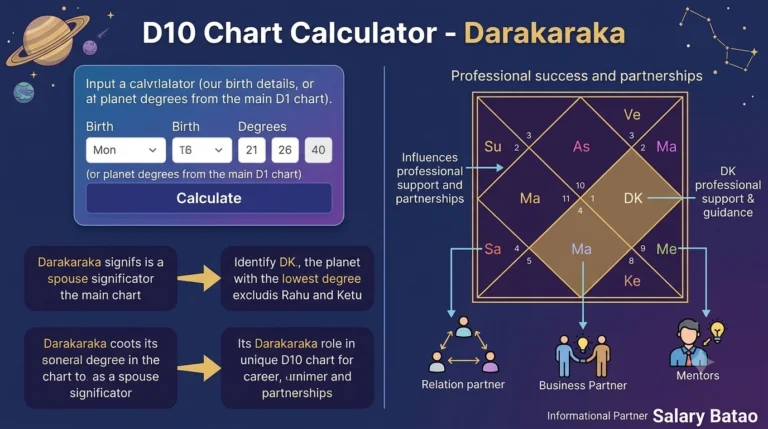
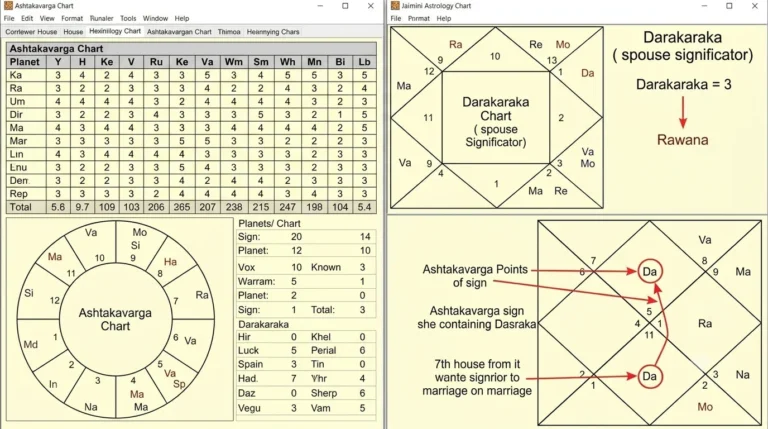
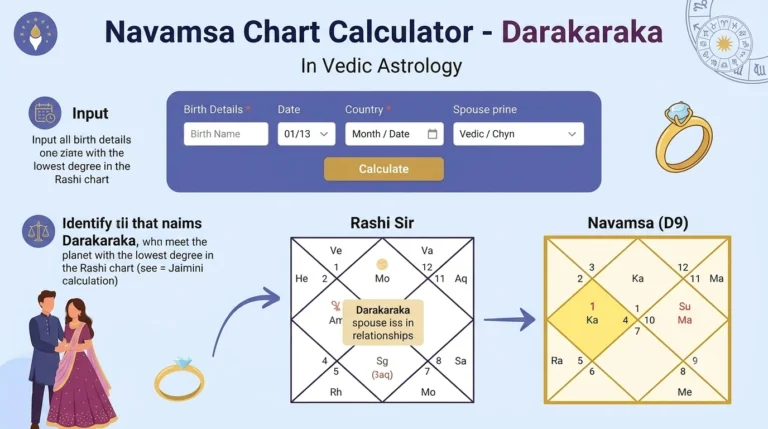
Darakaraka in Navamsa: The Spouse Signifier
In Jaimini astrology, planets can be assigned significator roles according to their degrees within their signs. In the seven-karaka scheme, the planet with the highest degree is the Atmakaraka, while the planet with the lowest degree is the Darakaraka (DK).
Rahu is excluded from this seven-karaka calculation in the approach described here.
How to Use Darakaraka With D9
- Identify the planet with the lowest degree in the D1 chart.
- Locate that planet in the Navamsa.
- Check its D9 sign and dignity.
- Note relevant conjunctions and aspects.
- Also examine the Navamsa position of the Atmakaraka when using Jaimini techniques.
Traditional Jaimini practitioners may use the Darakaraka’s Navamsa placement when discussing spouse and partnership themes. The Atmakaraka’s Navamsa sign is also used in the concept of Karakamsa.
Common Mistakes and Accuracy Checklist
✓ Birth time is as accurate as possible.
✓ Correct time zone is applied for the birth location and date.
✓ The correct birthplace is selected.
✓ Sidereal zodiac is selected if following Vedic astrology.
✓ Lahiri ayanamsa is selected if that is the system you intend to follow.
✓ Planetary degrees are checked when they are close to Navamsa boundaries.
✓ D9 Ascendant is treated carefully when birth time is uncertain.
✗ Do not rely on the Sun sign alone.
✗ Do not judge marriage from D9 alone.
✗ Do not compare charts generated with different ayanamsa settings without accounting for the difference.
Comparing D9 Chart Calculators
You may find several online tools, including D9 calculators from different astrology websites. If two calculators use identical birth data and calculation settings, their planetary Navamsa results should generally agree.
If they disagree, check these settings first:
- Ayanamsa
- Birth time
- Time zone
- Birth location
- Sidereal versus tropical zodiac
- Planetary calculation settings
- Rounding near Navamsa boundaries
Practical Tip: If you are checking your chart with two calculators, use identical settings first. If the results differ, compare the settings before assuming that either calculator is incorrect.
FAQs About D9 Chart Calculator
What is a D9 chart calculator?
It is an online Vedic astrology tool that converts your birth date, time and place into a Navamsa (D9) chart using a sidereal calculation system.
Is the D9 chart more important than D1?
D1 is the foundation of the horoscope, while D9 is traditionally used to refine planetary strength, marriage and other deeper themes. They are generally interpreted together rather than treating one as a replacement for the other.
Can I get a D9 chart calculator with degrees?
Yes. A useful calculator should ideally show the degree, minute and, where available, second of each planet. Degree information is especially helpful for identifying Navamsa boundaries and Vargottama placements.
How accurate is a free D9 chart calculator?
The mathematical calculation can be precise when the astronomical data, birth details and settings are correct. The quality of the resulting interpretation also depends on birth-time accuracy and the astrological system being used.
What does D9 tell about marriage?
Traditional Vedic astrology uses D9 to examine marriage, partnership, the 7th house and relevant planetary strength. It should not be used as the sole basis for predicting marriage.
What if my D1 planet is weak but strong in D9?
Traditional astrologers may interpret this as a situation where the planet has a more supportive underlying dignity than its D1 position alone suggests. The final interpretation depends on the complete chart.
Which ayanamsa should I use?
Lahiri (Chitra Paksha) is widely used for sidereal Vedic astrology, particularly in India. If you follow another tradition, use its recommended ayanamsa consistently.
Is the D9 chart the same as the Navamsa chart?
Yes. D9 refers to the ninth divisional chart, while Navamsa is the traditional name for that division.
What is the difference between D1 and D9?
D1, or the Rashi chart, is the primary birth chart used to examine the overall life pattern and planetary placements. D9 is a divisional chart traditionally used to refine planetary strength, marriage, dharma and related themes.
Do I need an exact birth time for a D9 chart?
A precise birth time is especially useful when interpreting the D9 Ascendant and its houses. Even a relatively small difference in birth time can matter when the Navamsa Ascendant is close to a boundary.
Conclusion
A D9 chart calculator is only the first step. Real understanding comes from knowing how the Navamsa is constructed, checking planetary degrees near Navamsa boundaries, using consistent ayanamsa settings, and reading D1 and D9 together.
For relationship-focused analysis, the 7th lord in D9, D9 7th house, Venus and relevant Jaimini factors such as Darakaraka can provide additional traditional perspectives. None of these factors should be interpreted in isolation.
Ready to check your Navamsa?
Generate your D9 chart and compare it with your D1 chart.
Disclaimer: Astrology is an interpretive tradition and is not a scientifically established prediction system. Use this content for learning and reflection, not as a substitute for professional advice on marriage, health or finances.