Ashtakavarga Chart: What It Means, How It’s Calculated, and How to Read It
Two people can have the exact same Moon sign — and still go through the exact same Saturn transit in completely different ways. Why? The answer lies in your Ashtakavarga chart, a 337-point system that many guides barely explain beyond “it’s eight-fold” and “higher points are good.”
This guide breaks down exactly what an Ashtakavarga chart is, how to calculate Ashtakavarga points step by step, how to read your Sarva Ashtakavarga table, and two refinement techniques — Trikona Shodhana and Ekadhipatya Shodhana — that most basic guides skip. By the end, you’ll also know exactly what that “40 points” number people search for actually means.
Quick Take: Ashtakavarga is a traditional Vedic astrology point system that assigns bindus to zodiac signs based on contributions from seven classical planets and the Ascendant. The combined Sarvashtakavarga has 337 total bindus, giving an average of about 28 points per sign.
What is Ashtakavarga?
Ashtakavarga comes from two Sanskrit words: Ashta (eight) and Varga (division or group). In simple terms, Ashtakavarga in Vedic astrology is a point-based system that measures how much support each planet receives across the 12 zodiac signs.
The system uses eight contributors:
- Sun
- Moon
- Mars
- Mercury
- Jupiter
- Venus
- Saturn
- Ascendant (Lagna)
Rahu and Ketu, the lunar nodes, are traditionally excluded from classical Ashtakavarga Chart calculations. This is why the system has eight contributors rather than nine or ten.
So what is Ashtakavarga in plain terms? It is a traditional method of converting planetary support from a qualitative idea such as “Jupiter is well placed” into a numerical measure such as “Jupiter has 6 out of 8 possible bindus in this sign.”
That numerical unit is called a bindu.
What is an Ashtakavarga Chart?
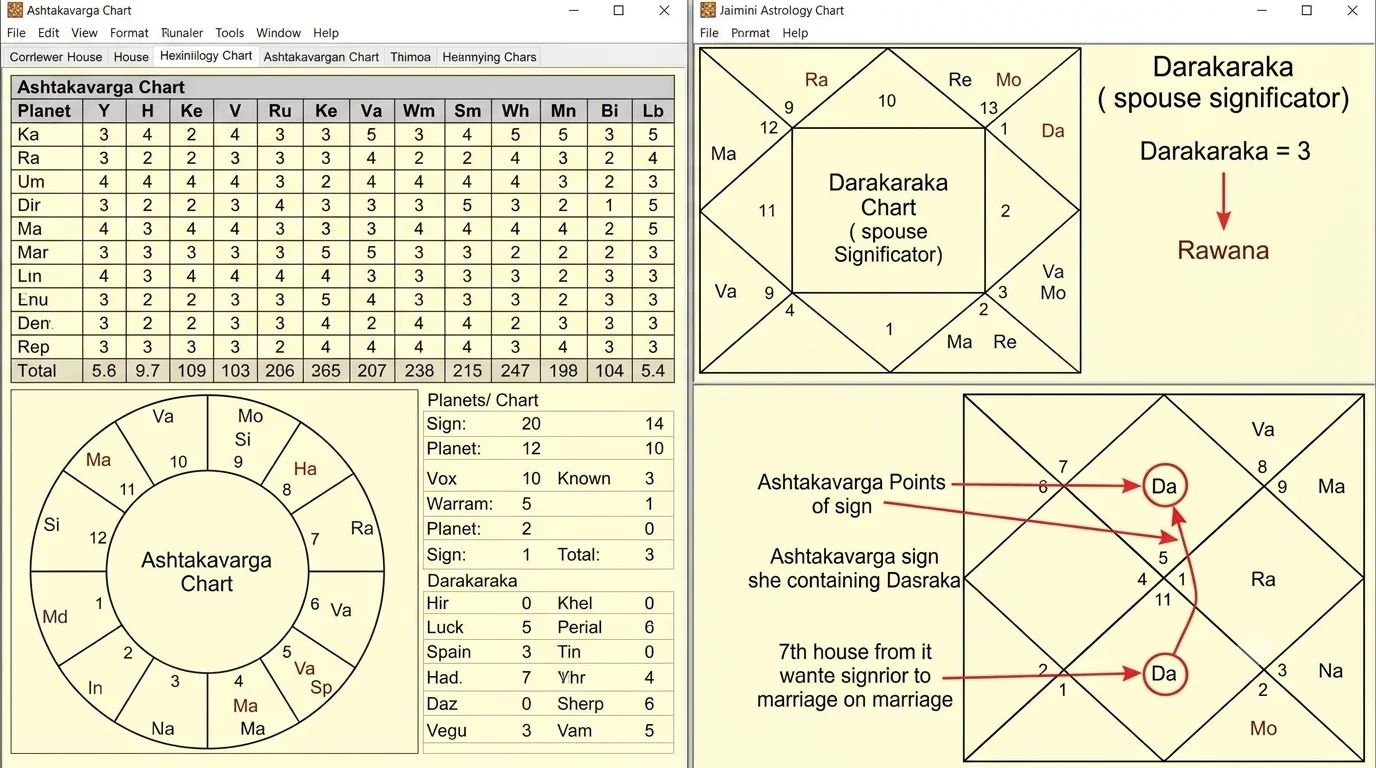
An Ashtakavarga chart, also called an Ashtakavarga Kundali or Ashtakavarga Kundli, is a table or grid displaying these bindu scores. It shows the 12 zodiac signs and the contribution or score associated with each planetary system.
There isn’t just one Ashtakavarga chart. There are seven individual planetary tables and one combined table:
The individual planetary tables are called Bhinnashtakavarga (BAV). The combined grand total is the Sarva Ashtakavarga or Sarvashtakavarga chart.
How to Calculate Ashtakavarga Points
Ashtakavarga calculation follows a defined set of traditional contribution rules. The basic process is:
1. Cast the natal chart.
Determine the exact sign placement of the seven classical planets and the Ascendant. Accurate birth time is important because the Ascendant changes relatively quickly.
2. Apply the classical contribution rules.
Each of the eight contributors has a defined set of houses counted from its position where it contributes a point to a particular planetary chart.
3. Mark bindus.
A bindu is marked when the relevant contribution rule is satisfied. Otherwise, the position receives no bindu.
4. Repeat for all seven planets.
This creates seven separate Bhinnashtakavarga tables.
Finally, the seven planetary rows are added together sign by sign to create the Sarvashtakavarga totals.
Doing this manually requires a large number of individual checks. That is why an Ashtakavarga calculator is useful: the logic is systematic, but the calculations are tedious and prone to manual errors.
The Kakshya System: The Timing Layer
Each 30° zodiac sign can be divided into eight Kakshyas, each measuring 3°45′. They are associated with the same eight contributors used in the Ashtakavarga framework.
In traditional Ashtakavarga practice, Kakshyas can be used to add another layer of detail to transit interpretation. When a transiting planet passes through a Kakshya associated with a contributor that has given a bindu, astrologers may use that period for more precise transit assessment.
Sarva Ashtakavarga Chart: The Combined Total
The Sarva Ashtakavarga chart adds the seven planetary Bhinnashtakavarga scores together for each zodiac sign.
A useful mathematical feature of the system is that each planet contributes a fixed total number of bindus across all 12 signs according to the classical rules.
Key Number: The seven planetary tables contain a combined total of 337 bindus. Dividing 337 by the 12 zodiac signs gives an average of approximately 28.08 points per sign. This is why 28 is a useful mathematical reference when comparing Sarvashtakavarga scores.
How to Read an Ashtakavarga Chart
Once you have an Ashtakavarga chart or table in front of you, the interpretation generally starts with comparing individual planetary scores and combined Sarvashtakavarga totals.
Bhinnashtakavarga: A sign receiving 4 or more bindus from a particular planetary table is traditionally treated as comparatively stronger than a sign receiving fewer points.
Sarvashtakavarga: Compare the combined sign total with the approximate 28-point average. Higher scores indicate relatively greater aggregate support within that chart.
Lower scores: A lower bindu count indicates comparatively less support from the contributing sources. It should not automatically be interpreted as an absolute negative result.
Zero bindus: A zero means none of the relevant contribution rules produced a bindu for that particular position. It is best interpreted in context rather than as an isolated pass/fail result.
The Truth About “40 Points” in Ashtakavarga Chart
A lot of people search for “40 points in Ashtakavarga”, expecting it to be a fixed reference number. But there is no universal 40-point benchmark that applies to every Sarvashtakavarga sign.
Here are the important numbers:
- No single planet has a universal total of exactly 40 bindus. Mars and Saturn are the closest at 39.
- The theoretical maximum for a single sign in Sarvashtakavarga is 56, based on seven planetary tables with a maximum of eight bindus each.
- The combined system contains 337 bindus distributed across 12 signs.
- The mathematical average is approximately 28.08 points per sign.
Remember: A score of 40 is possible as a high Sarvashtakavarga value, but it should not be treated as a fixed classical benchmark. The 28-point average is the more direct mathematical reference for comparing the 12 signs within the system.
Trikona Shodhana and Ekadhipatya Shodhana
This is where Ashtakavarga goes beyond the initial bindu count. Traditional calculations can apply additional reduction or refinement techniques known as Shodhana.
Trikona Shodhana
Trikona Shodhana compares the signs within the four trinal groups:
- 1st, 5th and 9th signs
- 2nd, 6th and 10th signs
- 3rd, 7th and 11th signs
- 4th, 8th and 12th signs
The scores are compared within each trinal group according to the traditional rules, with reductions applied where required. This process is intended to remove certain redundancies from the raw bindu totals.
Ekadhipatya Shodhana
Ekadhipatya Shodhana is applied to the planets that traditionally rule two zodiac signs: Mars, Mercury, Jupiter, Venus and Saturn. The Sun and Moon are excluded because each rules only one sign.
The two signs belonging to the same planetary lord are compared, and the traditional reduction rules are applied depending on planetary occupancy and the corresponding bindu values.
After these refinements, the resulting calculations can contribute to the determination of the Shodhya Pinda, which is used in more advanced Ashtakavarga applications, including certain longevity and transit calculations.
Ashtakavarga Chart Analysis: What Is It Used For?
Once the numbers are calculated, traditional astrologers may use Ashtakavarga as one layer of a broader chart analysis.
Is Ashtakavarga Chart Accurate?
Ashtakavarga is a classical technique within Vedic astrology and is traditionally associated with texts such as the Brihat Parashara Hora Shastra (BPHS). It is commonly used as a supplementary method alongside other astrological techniques.
However, astrology itself is not scientifically established as a predictive system. Within traditional practice, Ashtakavarga is generally treated as a strength-comparison and transit-analysis tool rather than a standalone yes-or-no prediction method.
The usefulness of a traditional Ashtakavarga reading also depends on the accuracy of the birth details and the method used to calculate and interpret the chart.
Important: Ashtakavarga should be understood as a traditional Vedic astrology technique. Its interpretations are matters of astrological tradition and should not be treated as scientifically proven predictions.
How to Get Your Free Ashtakavarga Chart by Date of Birth
You don’t need to perform hundreds of manual checks yourself. Our free Ashtakavarga Calculator on Darakaraka generates your complete Ashtakavarga chart using your birth details, including the seven Bhinnashtakavarga tables and combined Sarvashtakavarga totals.
To generate your chart, you’ll need:
- Date of birth
- Exact time of birth, as accurately as possible
- Place of birth
Enter these details into the calculator to generate your Ashtakavarga chart and then use the benchmarks and interpretation framework explained above to understand the resulting scores.
Ready to check your Ashtakavarga chart?
FAQs About Ashtakavarga Chart
What is Ashtakavarga in Vedic astrology?
It is a traditional point-based system that measures planetary contributions across the 12 zodiac signs using seven classical planets and the Ascendant as eight contributing sources.
What is an Ashtakavarga score?
It can refer to the bindu count in an individual Bhinnashtakavarga table or the combined Sarvashtakavarga total for a sign. An individual planetary sign score ranges from 0 to 8, while the theoretical Sarvashtakavarga maximum for one sign is 56.
How is Ashtakavarga calculated?
The calculation applies the classical contribution rules of the eight sources to each planetary table, marks the resulting bindus across the 12 signs, and then combines the seven planetary tables to produce the Sarvashtakavarga totals.
Is Ashtakavarga accurate?
It is a classical Vedic astrology technique used as a supplementary strength and transit-analysis method. Its interpretations are part of astrological tradition rather than scientifically established predictions.
What’s the difference between Bhinnashtakavarga and Sarva Ashtakavarga?
Bhinnashtakavarga is an individual planet’s bindu table across the 12 signs. Sarva Ashtakavarga combines the seven planetary Bhinnashtakavarga tables into one total for each sign.
Why does one of my houses show 0 bindus?
It means none of the relevant contribution rules produced a bindu for that position. A zero should be interpreted as a relative value within the complete chart rather than as an automatic negative result.
Can I check my Ashtakavarga chart online for free?
Yes. A free Ashtakavarga calculator can generate the seven Bhinnashtakavarga tables and combined Sarvashtakavarga values using your date, time and place of birth.
What does the “40 points” figure people search for actually mean?
There is no universal 40-point benchmark. The combined Sarvashtakavarga system contains 337 bindus across 12 signs, giving a mathematical average of about 28.08 points per sign. Individual planetary totals range from 39 for Mars and Saturn to 56 for Jupiter.
Final Thought: Ashtakavarga turns a complex set of traditional planetary relationships into a numerical framework. The most useful way to read it is not by focusing on one number in isolation, but by comparing the Bhinnashtakavarga scores, Sarvashtakavarga totals, relevant transits and the rest of the birth chart together.
Thank you for reading About Ashtakavarga Chart!
Check out our other Vedic Astrology Calculators and discover more about your birth chart.