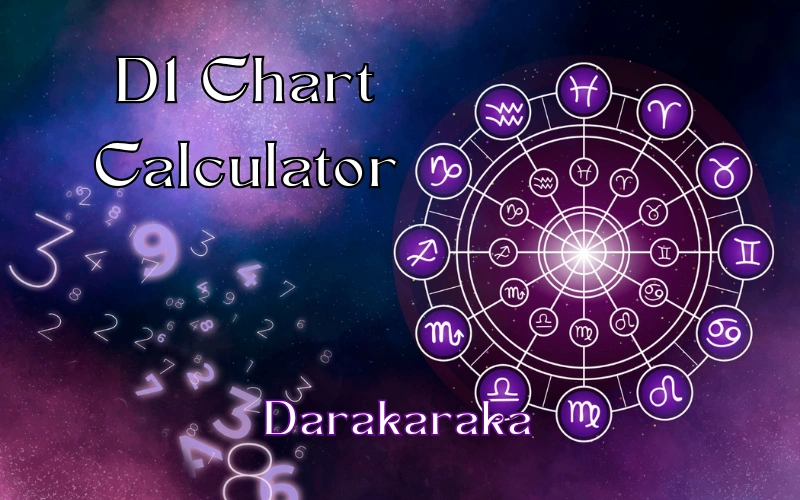
D1 Chart Calculator: The Simple 2026 Guide to Your Vedic Birth Chart
A D1 chart calculator generates your Rashi chart — the main birth chart in Vedic astrology — by plugging in your birth date, time, and place to map where each planet sat in the zodiac the moment you were born.
TL;DR
- The “D1” in D1 chart calculator stands for “Division 1” — it’s your primary, undivided birth chart.
- You need three inputs: exact birth date, exact birth time, and birth place.
- It’s also called the Rashi chart or Lagna chart, depending on which point you’re reading it from.
- A free D1 chart calculator gives you the same core chart as a paid one — the difference is usually in the extra interpretation layered on top.
- It’s a belief-based, traditional system, not a scientifically validated one — treat it as a lens for reflection, not a guarantee.
What Exactly Is a D1 Chart?
Think of your birth chart like a photograph of the sky, taken at the exact second you were born, from the exact spot you were born in. In Vedic astrology, that photograph gets divided into different “charts” depending on what you want to look at — career, marriage, health, and so on. There are sixteen of these divisional charts in classical use, and the D1 chart is the first and most important one. It’s the whole, undivided sky map — no cropping, no zooming in.
That’s why every Vedic D1 chart calculator starts here. It’s the foundation everything else (like the D9 chart for marriage, or the D10 for career) is built on top of.
Quick Facts
| What | Detail |
|---|---|
| Full name | Rashi Chart (also called Lagna Chart or D-1 Chart) |
| What it maps | Position of the Sun, Moon, and planets across 12 zodiac signs at birth |
| Inputs needed | Birth date, exact birth time, birth place (city + country) |
| Output | A 12-house chart showing your Ascendant (Lagna) and planetary placements |
| Used for | General personality, life pattern, and overall chart reading |
| Cost | Most D1 chart calculator free versions online are genuinely free — no payment needed for the base chart |
| Precision option | Some tools offer a D1 chart calculator with degrees, showing exact planetary degrees, not just the sign |
How a D1 Chart Calculator Actually Works
Here’s the part that trips people up — it’s not magic, it’s math. Here’s the honest, step-by-step version:
- You enter your birth details. Date, time (down to the minute, ideally), and place.
- The calculator finds your Ascendant (Lagna). This is whichever zodiac sign was rising on the eastern horizon at your exact birth moment — it becomes House 1 of your chart.
- It places the planets. Using astronomical position data (ephemeris tables), the tool calculates where the Sun, Moon, and other planets sat in the zodiac at that same moment.
- It builds the 12-house grid. Each house represents a different life area — self, wealth, communication, home, and so on — and each planet lands in a house based on your Ascendant.
- It hands you the chart. A basic Rashi D1 chart calculator stops there. Fancier tools add written interpretation, Ashtakavarga scoring, or a Sarva Ashtakavarga D1 chart calculator layer that scores each house’s strength.
Note:
Exact ephemeris precision and house-division methods can differ slightly between tools — if you’re using your chart for anything important, it’s worth cross-checking with a second calculator or a qualified astrologer.
Why Birth Time Precision (and “Degrees”) Matter
A lot of people wonder why the calculator keeps insisting on an exact birth time. Here’s the plain-English reason: your Ascendant sign can change roughly every two hours. If your birth time is off by even 15–20 minutes, your entire House 1 placement — and therefore your whole chart — can shift.
This is where a D1 chart calculator with degrees becomes genuinely useful rather than just a nice-to-have. Instead of just telling you “Moon in Taurus,” a degree-level calculator tells you it’s at, say, 14°32′ Taurus — which matters a lot if a planet is sitting right near the edge of two signs.
Rule of thumb: if your birth certificate or family records give you a time, use it. If you only have an approximate time (“morning,” “around noon”), say so — most modern calculators let you flag an estimated time so the reading accounts for the uncertainty.
D1 Chart vs. D9 Chart: What’s the Difference?
This is one of the most common follow-up questions, so let’s settle it with a table.
| Attribute | D1 Chart | D9 Chart (Navamsa) |
|---|---|---|
| Also called | Rashi Chart, Lagna Chart | Navamsa Chart |
| What it shows | Overall life pattern, personality, general strength of planets | Marriage, partnerships, and the “true” strength of a planet |
| When it’s used | First chart anyone reads | Second chart, read alongside the D1 |
| Calculation base | Direct planetary positions at birth | Each sign divided into 9 further parts (hence “D9”) |
| Common calculator pairing | Often bundled as a “D9 and D1 chart calculator” | Rarely offered without the D1 |
If you only remember one thing from this table: the D1 tells you who you are broadly; the D9 fine-tunes specific life areas, especially marriage.
Where People Usually Generate a D1 Chart
Most people reach for a free, browser-based tool rather than doing this by hand — and honestly, that’s the sensible move, since manual calculation involves ephemeris tables most of us don’t have memorized. Search results for terms like “D1 chart calculator Astrosage,” “D1 chart calculator Prokerala,” or “Astro Seek D1 chart calculator” point to some of the more commonly used platforms, alongside newer entrants sometimes marketed as a “Vedic Marga D1 chart calculator” or a “Cosmic Square” style tool.
Feature sets, ad-free versions, and paid add-ons vary and change often, so it’s worth comparing two or three directly rather than relying on any single platform’s own claims.
A Mini Glossary (Because the Jargon Is Half the Battle)
| Term | Plain-English Meaning |
|---|---|
| Rashi | Zodiac sign |
| Lagna | Ascendant — the sign rising at your birth moment |
| Bhava | House (one of the 12 life-area divisions) |
| Ashtakavarga | A scoring system that rates how strong each house/planet is |
| Navamsa (D9) | The marriage/partnership sub-chart |
| Ephemeris | The astronomical data table used to calculate planet positions |
Expert Insight: How to Actually Read Your First Chart
Once your D1 chart calculator spits out a chart, don’t try to read everything at once. Start with three things only: your Ascendant sign (your “mask to the world”), your Moon sign (your emotional default), and your Sun sign (your core drive). Everything else — house lords, aspects, Ashtakavarga scores — layers on top once those three make sense to you. Traditional Vedic astrology treats this as a skill built over years of study, so a first-pass reading from a free calculator is a starting point for reflection, not a final verdict.
Conclusion
A D1 chart calculator isn’t complicated once you strip away the jargon.
Get your birth time as accurate as possible, use a calculator that shows degrees if you want precision, and start your reading with just the Ascendant, Moon, and Sun before going deeper.
FAQs
1. Is a D1 chart calculator free to use?
Yes — the base Rashi chart is free on nearly every major platform. Paid tiers usually unlock written interpretations, PDF downloads, or advanced divisional charts, not the D1 chart itself.
2. What’s the difference between a Rashi chart and a Lagna chart?
Nothing, really — they’re two names for the same D1 chart, just emphasizing different reference points (the Moon sign vs. the Ascendant).
3. Can I calculate my D1 chart without knowing my exact birth time?
You can, but your Ascendant (House 1) may be inaccurate. Most calculators let you input an approximate time and will flag that the Ascendant is uncertain.
4. Why do some calculators show planetary degrees and others don’t?
Basic calculators simplify to just the zodiac sign. A D1 chart calculator with degrees is built for people who want to check exact planetary strength or borderline sign placements.
5. Do I need my D1 chart and D9 chart together?
Not required, but it’s common practice — the D1 gives the overall picture, and the D9 adds detail on partnerships and a planet’s true strength.
6. Are results from different D1 chart calculators the same?
They should be very close, since they’re all working from the same astronomical data. Small differences can appear based on the house-division method or ayanamsa (zodiac calculation standard) each tool uses — worth checking which standard a tool uses if you’re comparing two results.
7. Is a D1 chart calculator scientifically accurate?
The planetary position math is astronomically accurate. The interpretation of what those positions “mean” is part of a traditional belief system, not an empirically tested science — treat readings as a reflective tool rather than fact.
Disclaimer:
This article is for general informational and entertainment purposes. Vedic astrology is a traditional belief system; nothing here should replace professional advice (medical, financial, legal, or otherwise) or a consultation with a qualified astrologer.
Thank you for reading!
Check out our other Vedic Astrology Calculators and discover more about your birth chart.